 +43 1 226 5567

300+ vasectomies performed to date
Sat Vasectomies on Saturdays tooStep by step.
The vasectomy procedure
From the first conversation to the final check: what happens when, how you prepare, and what the first few days afterwards look like.
In brief
A vasectomy runs in four stages: a consultation with an examination, a few days to think it over, the outpatient procedure of around 30 minutes under local anaesthetic, and the follow-up semen analysis no earlier than ten weeks later. Only once that is clear does the contraception count as reliable.
1. The consultation
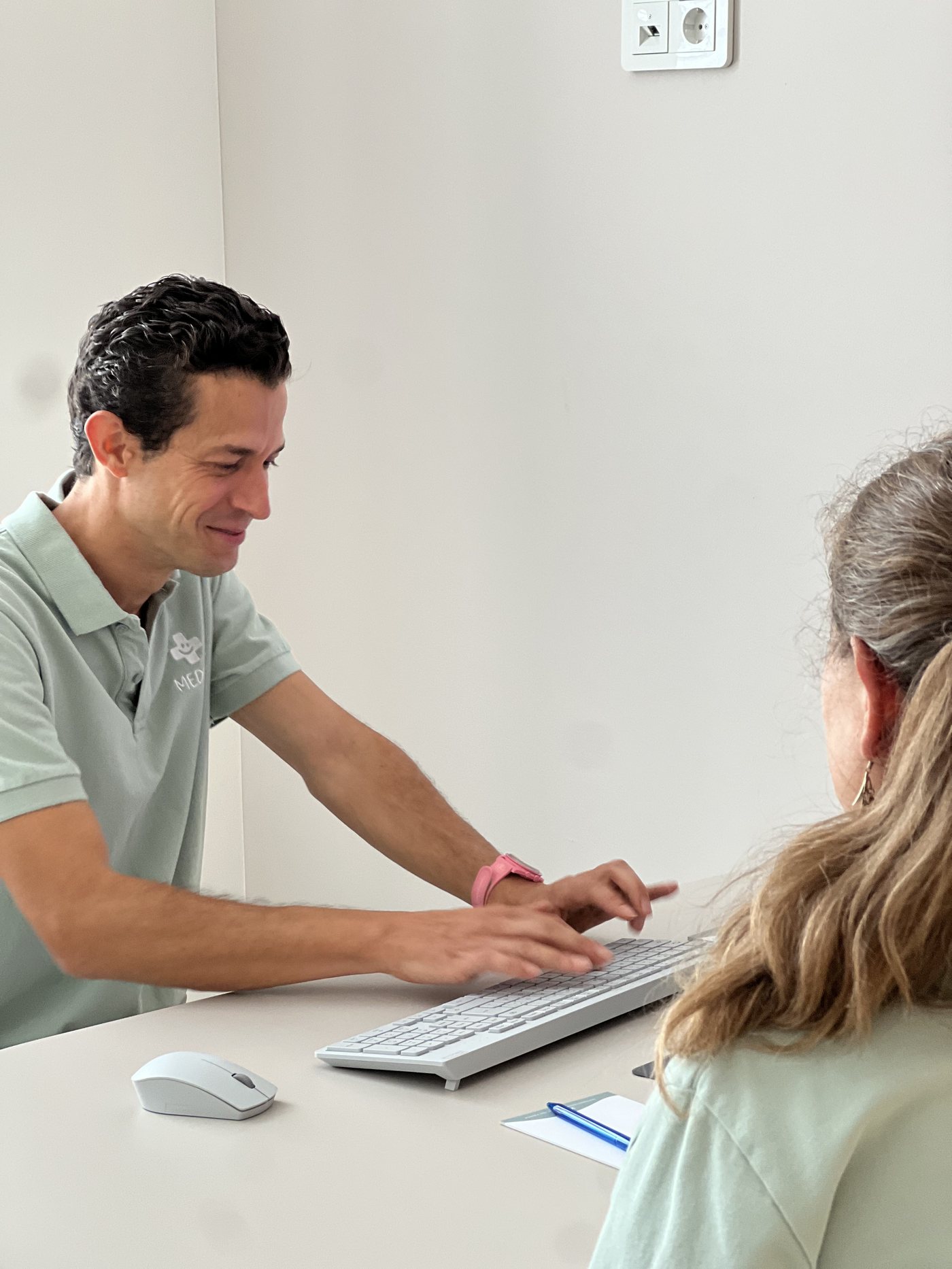
Dr Suarez-Ibarrola will ask about your family planning, previous illnesses, medication and any earlier operations in the groin. During the examination he palpates the testicles and the vasa deferentia. That shows in advance whether everything points anatomically to a straightforward procedure.
Then it is about you: why now? What if your circumstances change? Would you like to freeze sperm beforehand? You take the written information home with you. Your partner is very welcome to come along.
2. Time to think it over
A few days deliberately pass between the information and the procedure. A vasectomy is intended as a permanent decision. Anyone who hesitates should wait. Anyone who is certain loses nothing by waiting a few days.
3. Preparing at home
- Shave the scrotum and the skin above it the day before or that morning
- Shower on the day and have your usual breakfast
- Bring close-fitting underwear or a support
- Pause blood thinners only after discussing it
- Arrange for someone to accompany you home, or plan to use public transport
Tip: the Saturday service day
A vasectomy is also possible on a Saturday. The procedure on Saturday, Sunday for resting and cooling, and with a desk job most men are back at their desk on Monday. That way most men need no annual leave at all. Simply book a Saturday appointment.
The no-scalpel technique
A tiny opening instead of an incision
The no-scalpel vasectomy was developed in China in the 1970s and is an established approach today. Dr Suarez-Ibarrola uses it at MEDINO.
Conventional
With a scalpel
- One or two skin incisions of around 1 to 2 cm
- The wound is stitched
- More frequent bruising and swelling
With Dr Suarez-Ibarrola
No-scalpel
- A tiny skin opening of a few millimetres in the middle
- Under local anaesthetic
- Less bruising, less pain and fewer infections
What happens in detail
After the local anaesthetic, Dr Suarez-Ibarrola locates the vas deferens through the skin and holds it in place with a small ring clamp just beneath the surface. Using fine, pointed forceps, the skin is punctured at a single point and gently stretched rather than cut open. Through this tiny opening the vas deferens is lifted out, divided, sealed and returned. He reaches the second vas deferens through the same opening.
What the studies show
A Cochrane review of randomised trials found less bruising, less pain during and after the procedure and fewer infections with the no-scalpel technique, at the same effectiveness. In a comparative study cited by the US guideline, the rate of bruising was 1.8 % rather than 12.2 % with the incision technique. The 2026 AUA guideline therefore recommends a minimally invasive approach such as no-scalpel.
What that means for you
A shorter procedure, barely visible traces and, as a rule, a quicker return to everyday life. The technique changes nothing about how the vasa deferentia themselves are sealed: that follows the recommendations of the guideline.
On the day of the procedure
Around 30 minutes, awake and with little pain
You lie comfortably, stay responsive throughout and can ask questions at any time.
- Local anaesthetic
A fine injection numbs the skin and both vasa deferentia. That is usually the only moment you feel.
- No-scalpel access
No incision: through a tiny skin opening of a few millimetres the vas deferens is grasped with a small clamp and lifted out. More on the technique.
- Dividing and sealing
The vas deferens is divided, the ends are cauterised and separated from one another by a layer of tissue. The US guideline recommends this combination because it shows the lowest failure rate.
- The second side
The second vas deferens is reached through the same opening.
- A short rest, then home
After a brief period of observation you go home with clear instructions and an appointment for the semen analysis.
Afterwards
The first days and weeks
- Day 0–2Rest and cool
Keep it elevated, cool with an ice pack wrapped in a cloth, wear close-fitting underwear. Mild pain and swelling are normal; ordinary painkillers help.
- From day 1Showering allowed
Baths, sauna and swimming only after about a week, once the small wounds have closed.
- Day 1–2Back at your desk
With a desk job, usually no problem. Still avoid heavy lifting.
- From about 1 weekSport and sex
Once nothing hurts any more. Carry on with contraception, because sperm are still present in the ducts above the point of division.
- From week 8Follow-up semen analysis
Only a clear result makes the vasectomy reliable contraception. Everything about the semen analysis.
Questions & answers
Questions about the procedure
What does no-scalpel mean?
Instead of an incision with a scalpel, the skin is punctured at a single point with fine forceps and stretched. Both vasa deferentia are reached through this opening of a few millimetres, under local anaesthetic.
Do I have to fast beforehand?
No. The procedure is carried out under local anaesthetic. Eat as you normally would beforehand; that helps prevent circulatory problems.
May I drive myself home afterwards?
Better not. Arrange to be collected or travel home by public transport. Pressure and jolting do you no good in the first few hours.
Do I have to stop taking blood thinners?
You discuss that with Dr Suarez-Ibarrola at the preliminary consultation. Never stop prescribed medication on your own initiative. If you take aspirin or other blood thinners, please say so early on.
When can I have sex again?
Usually after about a week, once nothing hurts any more. Important: carry on with contraception until the follow-up semen analysis is clear.
When can I return to my job?
With a desk job, usually after one to two days. If your job is physically demanding, allow about a week.
Sources
Guidelines & studies
Everything on this page is based on current guidelines and peer-reviewed studies:
- AUA Guideline: Vasectomy (2026)American Urological Association. Technique, follow-up semen analysis, complication rates
- Cook LA et al.: Scalpel versus no-scalpel incision for vasectomyCochrane Database of Systematic Reviews 2014
- Cook LA et al.: Vasectomy occlusion techniques for male sterilizationCochrane Database of Systematic Reviews 2014
- EAU Guidelines: Sexual and Reproductive Health (vasectomy chapter)European Association of Urology, updated annually

Consultation
Your vasectomy consultation
The first conversation commits you to nothing. You are welcome to come as a couple. Appointments until 8pm and on Saturdays, in German, English or Spanish.
By phone: +43 1 226 5567 · servus@medino.at
Medically reviewed and approved by Dr. Rodrigo Suarez-Ibarrola, BSc, specialist in urology and andrology, on 19 November 2026